qsimlab.qec — memory circuits, detector sampling, error models, decoders¶
Status: provisional (phase 2; see ../API.md §1, §8 and the qsimlab.qec
section). The pipeline is build → sample → decode → count, every heavy step runs in Rust with
the GIL released, and everything is cross-checked against Stim and PyMatching
(python/tests/test_qec.py).
| what | function / class | engine underneath |
|---|---|---|
| surface code memory (rotated, X or Z basis) | surface_code_memory(d, rounds, basis, p=, noise=) |
new generator (python/src/qec.rs), Stim's layout and hook-safe CNOT order |
| repetition code memory | repetition_code_memory(d, rounds, p=, noise=) |
new generator |
| colour code memory (6.6.6, K–F rounds, flags) | color_code_memory(d, rounds, basis, schedule=, flags=, p=, noise=) |
qsim_lab::qec::color::memory_flagged |
| detection events | sample_detectors(c, shots, seed=, engine=), DetectorSampler |
FastSampler (research/qec/fast-sampler.md) / SymPhase |
| detector error model | detector_error_model(c) → DetectorErrorModel (to_stim_dem, from_stim_dem, matrices, graphlike) |
SymPhase symbolic frame |
| exact circuit distance + count | circuit_distance(c, max_weight=, detectors=, timeout=) |
qsim_lab::qec::distance (branch and bound) |
| decoding | decode(dem, dets, "bposd" \| "pymatching" \| "tesseract"), make_decoder |
qsim_lab::qec::bposd; PyMatching / Tesseract adapters |
| logical error rate | logical_error_rate(c, shots, decoder=, seed=, max_errors=, rounds=) |
fused sample + BP+OSD in Rust, or Python chunks for other decoders |
Circuits are ordinary qsimlab.Circuits: detectors and observables are absolute measurement
indices (c.detectors, c.observables), every noise location is an explicit op, and
c.to_stim() is exactly the circuit that is sampled. return_layout=True also returns a
CodeLayout (qubit roles and coordinates, per-detector (x, y, round), stabilizer basis, flag
detectors, and memory_detectors, the sector the observable lives in).
Tutorial: a surface code memory, end to end¶
Build a distance-3 Z-basis memory with three rounds under SI1000 noise at p = 0.3%:
>>> import numpy as np
>>> import qsimlab.qec as qec
>>> c, layout = qec.surface_code_memory(3, rounds=3, basis="Z", p=3e-3, noise="si1000",
...                                     return_layout=True)
>>> c.num_qubits, len(c.detectors), len(c.observables), len(layout.memory_detectors)
(17, 24, 1, 16)
>>> print(c.to_stim().splitlines()[0])           # the exact sampled circuit, in Stim format
R 0 1 2 3 4 5 6 7 8 9
Sample detection events. A DetectorSampler compiles once (the SymPhase frame and the
FastSampler's hit tables) and samples many times; seeds are reproducible for any thread count:
>>> sampler = qec.DetectorSampler(c)
>>> sampler
DetectorSampler(engine='fast', detectors=24, observables=1)
>>> dets, obs = sampler.sample(100_000, seed=2026)
>>> dets.shape, dets.dtype, round(float(dets.mean()), 3)
((100000, 24), dtype('bool'), 0.075)
>>> packed, _ = sampler.sample(100_000, seed=2026, packed=True)   # Stim's bit_packed layout
>>> bool((np.unpackbits(packed, axis=1, count=24, bitorder="little") == dets).all())
True
The detector error model is read off the same symbolic frame. Its text is Stim's DEM format
(and it equals Stim's detector_error_model() of c.to_stim(), see the tests):
>>> dem = qec.detector_error_model(c)
>>> dem
DetectorErrorModel(detectors=24, observables=1, errors=219)
>>> dem.to_stim_dem().splitlines()[0]
'error(0.006791033333739869) D0'
The circuit-level distance is exact: the smallest number of error mechanisms that flip the logical observable without firing a detector, plus the number of such minimum-weight logicals:
Decode the samples. BP+OSD is built in; PyMatching and Tesseract are used if installed:
>>> pred = qec.decode(dem, dets, "bposd")
>>> int((pred != obs).any(axis=1).sum())          # failures out of 100,000
2502
>>> pred = qec.decode(dem, dets, "pymatching")   # doctest: +SKIP
>>> int((pred != obs).any(axis=1).sum())          # doctest: +SKIP
2798
BP+OSD decodes the full hypergraph DEM (it sees the correlation between the X and Z parts of a Y error); matching needs graphlike edges and loses that information, hence the higher count.
Finally, the logical error rate against p for d = 3, 5, 7 (each point stops after 1000 failures;
rounds=d also reports a per-round rate). This is how qec_ler.png below was made, with
shots=1_000_000:
>>> rows = []
>>> for d in (3, 5):
...     for p in (1e-3, 2e-3, 4e-3):
...         circuit = qec.surface_code_memory(d, d, p=p, noise="si1000")
...         r = qec.logical_error_rate(circuit, 10_000, seed=1, decoder="bposd", rounds=d)
...         rows.append((d, p, r.rate, r.ci))
>>> [round(rate, 4) for d, p, rate, ci in rows]                # doctest: +SKIP
[0.0028, 0.0098, 0.0416, 0.001, 0.0064, 0.0394]
>>> import matplotlib                                          # doctest: +SKIP
>>> matplotlib.use("Agg")                                      # doctest: +SKIP
>>> import matplotlib.pyplot as plt                            # doctest: +SKIP
>>> fig, ax = plt.subplots()                                   # doctest: +SKIP
>>> for d in (3, 5):                                           # doctest: +SKIP
...     x = [p for dd, p, _, _ in rows if dd == d]
...     y = [rate for dd, _, rate, _ in rows if dd == d]
...     err = [[rate - ci[0] for dd, _, rate, ci in rows if dd == d],
...            [ci[1] - rate for dd, _, rate, ci in rows if dd == d]]
...     _ = ax.errorbar(x, y, yerr=err, marker="o", label=f"d = {d}")
>>> ax.set_xscale("log"); ax.set_yscale("log"); _ = ax.legend()  # doctest: +SKIP
>>> fig.savefig("ler.png")                                      # doctest: +SKIP
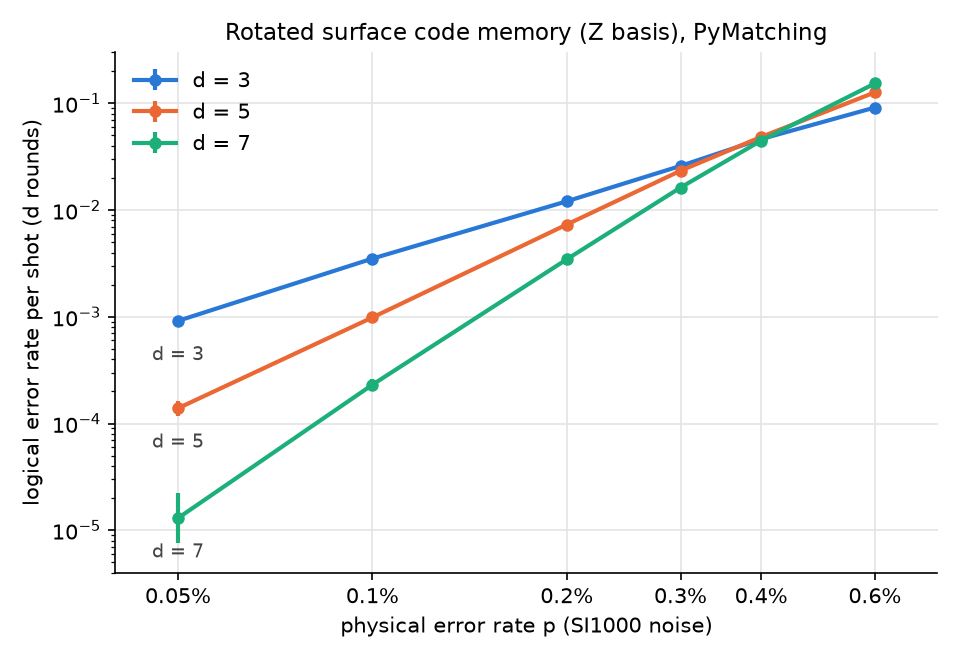
(1,000,000 shots per point or 1000 failures, Wilson 95% intervals; 80 s for all 18 points on the loaded VPS.)
Noise models¶
noise= picks the model and p= its strength. Every location is an explicit op of the circuit
(the readout flip is circuit.readout_error, Stim's M(p)).
| model | after CNOT | idle, gate layer | idle, measure/reset layer | readout flip | reset flip |
|---|---|---|---|---|---|
"cnot" |
DEPOLARIZE2(p) |
– | – | – | – |
"uniform" |
DEPOLARIZE2(p) |
DEPOLARIZE1(p) |
DEPOLARIZE1(p) |
p | p |
"si1000" |
DEPOLARIZE2(p) |
DEPOLARIZE1(p/10) |
DEPOLARIZE1(2p) |
5p | 2p |
Measurement and reset in the X basis are MX = H M H and RX = R H with the flip applied in
the right basis (Z_ERROR after RX); these basis changes carry no gate noise. SI1000 follows
Gidney et al. (the auxiliaries are reset/measured in their stabilizer's basis instead of using
explicit Hadamards, so it has no single-qubit gate layers). For the colour code "cnot" and
"uniform" are exactly the engine's ColorNoise models used in research/qec/qec-r4.md and
research/qec/colour-global.md; "si1000" is the uniform circuit with each location rescaled.
Colour codes: schedules and flags¶
schedule= accepts "kf" (Kishony–Fowler, the default), "tri" (Lee et al.'s tri-optimal),
"global" (the exact schedules of research/qec/colour-global.md: d = 9 with circuit distance 8
against K–F's 7, and d = 11 with 7 + 7 layers and distance 10), a .sched file, or a
(plaquettes, 6) array. flags=True puts a flag qubit on every boundary-touching plaquette
(research/qec/colour-flags.md). The sector search makes these distances cheap:
>>> kf, lk = qec.color_code_memory(9, 1, schedule="kf", p=1e-3, return_layout=True)
>>> r = qec.circuit_distance(kf, detectors=lk.memory_detectors)
>>> r.distance, r.certified
(7, True)
Engines, seeds and performance¶
engine="auto"(default) uses the FastSampler and falls back to the plain SymPhase sampler (same distribution, slower) withDetectorSampler.noteset if the FastSampler rejects the circuit;"fast"/"symphase"force one. No circuit expressible inqsimlabhas needed the fallback so far: the FastSampler handles every SymPhase variable group (flips, depolarizing channels, coins).- Shots are drawn in chunks of 1024 from independent wyrand streams seeded by
(seed, chunk), in parallel; the same seed gives the same samples for anythreads=. logical_error_rate(..., max_errors=k)checks the stopping rule every 65,536 shots, so its result is also seed-reproducible.
Throughput¶
VPS (AMD EPYC-Rome, 4 vCPU, AVX2), 1-minute load 11.5–12.5 from other jobs, so absolute
numbers are pessimistic; the four contenders were interleaved (order alternating), min of 3.
Circuit: Stim's surface_code:rotated_memory_z, rounds = d, all four noise knobs p = 0.1%, the same
.stim text for everyone (qs.Circuit.from_stim). Mshot/s, compile excluded:
| d | detectors | shots | Rust bench (stim_compare bench-fast, 1 thread) |
transposed=True, 1 thread |
packed=True, 1 thread |
bool, 1 thread | transposed, 4 threads |
packed, 4 threads |
Stim pip sample(bit_packed=True) |
|---|---|---|---|---|---|---|---|---|---|
| 3 | 24 | 4,000,000 | 673.5 | 526.0 | 76.6 | 47.5 | 646.9 | 164.9 | 9.2 |
| 7 | 336 | 1,000,000 | 57.9 | 25.3 | 15.5 | 5.0 | 33.3 | 27.8 | 0.71 |
| 11 | 1320 | 256,000 | 10.9 | 4.6 | 4.8 | 1.2 | 6.5 | 5.8 | 0.19 |
| 15 | 3360 | 128,000 | 4.5 | 1.9 | 2.2 | 0.54 | 3.0 | 3.0 | 0.06 |
- The sampler behind the binding is the Rust bench's: timed inside the extension with no output
conversion (
DetectorSamplerCore._bench), it gave 948 / 76 / 5.1 Mshot/s at d = 3 / 7 / 15 (1 thread, same session, load ~16), at or above the bench's own numbers. - What the Python call adds is producing a fresh numpy array: first-touch page faults on the
output (42 MB at d = 7, 1M shots, detector-major) and, for the shot-major layouts, a 64×64 bit
transposition per block (Stim's
bit_packedlayout). The bool layout writes 8× more bytes. - Against Stim's Python sampler on the same machine: 8–36× (1 thread,
packed, the like-for-like layout). Compile: 0.2 ms (d = 3) to 80–130 ms (d = 15).
Limitations¶
- Circuits must be Clifford with Pauli noise (
x/y/z_error,depolarize1/2, readout flips) and no classically controlled gates;UnsupportedOperationErrorotherwise. - At most 64 observables for the decoders (BP+OSD returns a 64-bit mask).
circuit_distance: exponential in the distance; the full DEM of large colour codes takes minutes (usedetectors=layout.memory_detectors, which is exact whencertified).timeout=is approximate (the node budget per weight is set from the measured search rate).- BP+OSD (the engine's decoder) runs OSD on many shots of large surface codes (~0.6 ms per shot at d = 5, p = 0.3% on the loaded VPS); for surface codes PyMatching is much faster.
- The PyMatching adapter decomposes hyperedges into graphlike mechanisms that exist in the model
(
DetectorErrorModel.graphlike()); mechanisms it cannot decompose are dropped with a warning. si1000for the colour code rescales the uniform circuit's locations by moment kind; for a hand-written schedule whose first CNOT layer is empty the idle noise of that layer would be classified as a reset layer's (2pinstead ofp/10).- Detector coordinates live in the
CodeLayout, not in the circuit (Circuithas no coordinate annotations;to_stim()writes noQUBIT_COORDS).